
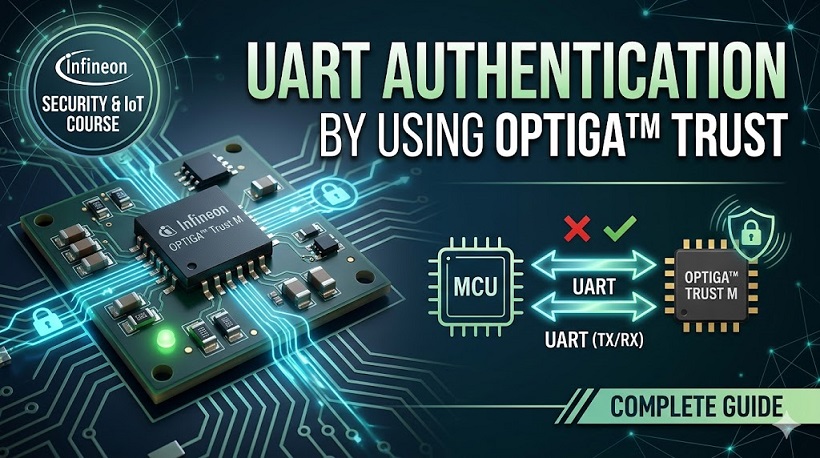
UART authentication by using Optiga trust-m demostration

TESA

ในยุคของระบบฝังตัว (Embedded Systems) และอุปกรณ์ IoT ที่มีการเชื่อมต่อกันอย่างแพร่หลาย ความปลอดภัยของการสื่อสารระหว่างอุปกรณ์ถือเป็นสิ่งสำคัญอย่างยิ่ง โดยเฉพาะการสื่อสารผ่านโปรโตคอลพื้นฐานอย่าง UART (Universal Asynchronous Receiver/Transmitter) ซึ่งแม้จะมีความเรียบง่ายและใช้งานสะดวก แต่ก็มีความเสี่ยงด้านความปลอดภัย เช่น การดักฟังข้อมูล (eavesdropping) หรือการปลอมแปลงอุปกรณ์ (device spoofing)

เพื่อแก้ไขปัญหาดังกล่าว การนำฮาร์ดแวร์ด้านความปลอดภัยเข้ามาช่วยจึงเป็นแนวทางที่มีประสิทธิภาพ หนึ่งในโซลูชันที่ได้รับความนิยมคือ OPTIGA™ Trust M จาก Infineon Technologies ซึ่งเป็น Secure Element ที่ออกแบบมาเพื่อจัดเก็บกุญแจเข้ารหัส (cryptographic keys) และดำเนินการด้านความปลอดภัย เช่น การยืนยันตัวตน (authentication) และการเข้ารหัสข้อมูล (encryption) โดยไม่เปิดเผยกุญแจสำคัญออกสู่ภายนอก

การสาธิต (demonstration) นี้มีวัตถุประสงค์เพื่อแสดงแนวทางการประยุกต์ใช้ OPTIGA™ Trust M ในการยืนยันตัวตนของอุปกรณ์ผ่านการสื่อสารแบบ UART โดยเน้นการป้องกันการเข้าถึงจากอุปกรณ์ที่ไม่ได้รับอนุญาต และเพิ่มความน่าเชื่อถือของระบบ ตัวอย่างการใช้งานนี้เหมาะสำหรับงานด้าน Embedded Security, Automotive, และ Industrial IoT ที่ต้องการยกระดับความปลอดภัยโดยไม่เพิ่มความซับซ้อนของระบบมากเกินไป

In the era of Embedded Systems and widely connected IoT devices, securing communication between devices has become critically important. This is especially true for fundamental communication protocols such as UART (Universal Asynchronous Receiver/Transmitter). Although UART is simple and easy to use, it presents several security risks, including eavesdropping and device spoofing.

To address these challenges, integrating hardware-based security solutions is an effective approach. One of the widely adopted solutions is OPTIGA™ Trust M from Infineon Technologies, a secure element designed to securely store cryptographic keys and perform security operations such as authentication and data encryption without exposing sensitive keys externally.

This demonstration aims to present an approach for applying OPTIGA™ Trust M to enable device authentication over UART communication. The focus is on preventing unauthorized device access and enhancing system trustworthiness. This example is particularly suitable for applications in Embedded Security, Automotive, and Industrial IoT, where improving security is essential without significantly increasing system complexity.

1. บทนำและภาพรวม

  • ความสำคัญของความปลอดภัยในการสื่อสารผ่าน UART
  • แนะนำ OPTIGA™ Trust M และบทบาทในการป้องกันข้อมูล
  • การประยุกต์ใช้งาน Security UART ในอุปกรณ์ฝังตัว (Embedded Devices)

2. พื้นฐาน Security UART

  • UART คืออะไร และการทำงานพื้นฐาน
  • จุดอ่อนด้านความปลอดภัยของ UART
  • แนวทางการป้องกันและการดึงข้อมูล

3. แนะนำ OPTIGA™ Trust M

  • ฟีเจอร์และความสามารถหลักที่เกี่ยวข้องกับ UART Security
  • การจัดเก็บคีย์ การเข้ารหัส และการยืนยันตัวตนบนอุปกรณ์
  • การทำงานร่วมกับโปรโตคอล UART

4. การตั้งค่าและการเชื่อมต่อ

  • การเตรียมอุปกรณ์และซอฟต์แวร์สำหรับ UART Security
  • การสร้างคีย์และการตั้งค่า OPTIGA™ Trust M
  • การกำหนดค่า UART Secure Communication

 5. การสาธิตการใช้งาน

  • การเปิดใช้งานดีบักข้อมูลผ่าน UART
  • การแก้ไขปัญหาที่พบระหว่างการสาธิต

6. การสรุปและคำแนะนำ

  • แนวทางปฏิบัติที่ดีสำหรับ Security UART
  • ตัวอย่างการประยุกต์ใช้งานจริงในอุตสาหกรรม
  • คำแนะนำสำหรับการพัฒนาและทดสอบอุปกรณ์ฝังตัว


  1. Introduction and Overview
  • The importance of secure communication over UART
  • Introduction to OPTIGA™ Trust M and its role in data protection
  • Applications of Security UART in embedded devices
  1. Basics of Security UART
  • What UART is and its basic operation
  • Security vulnerabilities of UART
  • Approaches for protection and secure data retrieval
  1. Introduction to OPTIGA™ Trust M
  • Key features and capabilities relevant to UART security
  • Key storage, encryption, and device authentication
  • Integration with UART protocols
  1. Setup and Connection
  • Preparing hardware and software for UART security
  • Creating keys and configuring OPTIGA™ Trust M
  • Configuring secure UART communication
  1. Demonstration
  • Enabling debug data over UART
  • Troubleshooting issues encountered during the demonstration
  1. Summary and Recommendations
  • Best practices for Security UART
  • Examples of real-world industrial applications
  • Recommendations for developing and testing embedded devices 


Enroll